


Pre-Conception and Pre-Natal Diagnostic Techniques (PCPNDT) Act
Syllabus: GS2/ Health/ Governance
Context
- The growing use of portable ultrasound devices has raised debate that the PCPNDT Act, 1994 needs to be updated to support better healthcare access while preventing the misuse of ultrasound for illegal sex determination.
What is the PCPNDT Act?
- The PCPNDT Act was introduced in 1994 to curb prenatal sex determination and the selective abortion of female foetuses in response to a declining child sex ratio.
- It was amended in 2003 to expand its scope from regulating prenatal diagnostic techniques to also prohibiting pre-conception sex selection through modern reproductive technologies.
- Punishment:
- First offence: Up to 3 years imprisonment and fine up to ₹10,000.
- Subsequent offences: Up to 5 years imprisonment and higher fines.
- Medical practitioners may face suspension or cancellation of registration by the State Medical Council.
Key Provisions of the Act
- Regulation of Diagnostic Techniques: Prenatal diagnostic techniques may be used only for detecting specific genetic or congenital abnormalities, chromosomal disorders, metabolic disorders, haemoglobinopathies, or sex-linked diseases.
- Every genetic counselling centre, laboratory, clinic, ultrasound clinic, and imaging centre must be registered under the Act.
- Restriction on Advertisements: Any advertisement promoting sex determination or sex selection services is prohibited.
- Record Maintenance: Registered clinics must maintain prescribed records of every prenatal diagnostic procedure.
- Failure to maintain records is treated as a violation under the Act.
Source: TH
AIR SUVIDHA 2.0 Portal
Syllabus: GS2/ Health/ Governance
Context
- The Ministry of Civil Aviation and Delhi International Airport Limited (DIAL) launched Air Suvidha 2.0.
Air Suvidha 2.0 Portal
- It is an upgraded contactless Passenger Health Self-Declaration Portal, to strengthen public health surveillance at Points of Entry.
- The launch follows the WHO’s declaration of the Ebola/Bundibugyo virus disease outbreak in the Democratic Republic of the Congo (DRC) and Uganda as a Public Health Emergency of International Concern (PHEIC).
- Developed in collaboration with the Directorate General of Health Services (DGHS), Ministry of Health & Family Welfare, the portal enables International arriving passengers to submit a mandatory online Health Self-Declaration — covering 21-day travel history, exposure history and related symptoms, if any — prior to immigration clearance.
- The portal enables real-time data sharing with the Airport Health Officer, Bureau of Immigration, IDSP and State Surveillance Officers, enabling swift identification and referral of at-risk travellers.
What is Bundibugyo virus disease?
- Bundibugyo virus disease (BVD) is a rare and potentially deadly type of viral hemorrhagic fever. It is caused by Bundibugyo virus, a type of Ebola virus.
- BVD has caused two previous outbreaks, one in Uganda in 2007 and one in DRC in 2012.
- BVD is spread by contact with the blood or bodily fluids of a person who is infected with or has died from BVD.
- It is also spread by contact with contaminated objects or by contact with animals, such as bats and nonhuman primates, that are infected with BVD.
- Symptoms include fever, headache, muscle pain, weakness, diarrhea, vomiting, stomach pain, and unexplained bleeding or bruising (a late stage of illness).
- There are no vaccines or specific treatments approved to prevent or treat BVD.
Source: PIB,
Bandipur and Nagarahole Tiger Reserves
Syllabus: GS3/ Environment
Context
- The Karnataka Government announced the full restoration of the jungle safari (park excursion) at the Bandipur and Nagarahole Tiger Reserves, suspended since November 2025 in the wake of human-tiger conflict in the region.
Bandipur and and Nagarahole Tiger Reserves
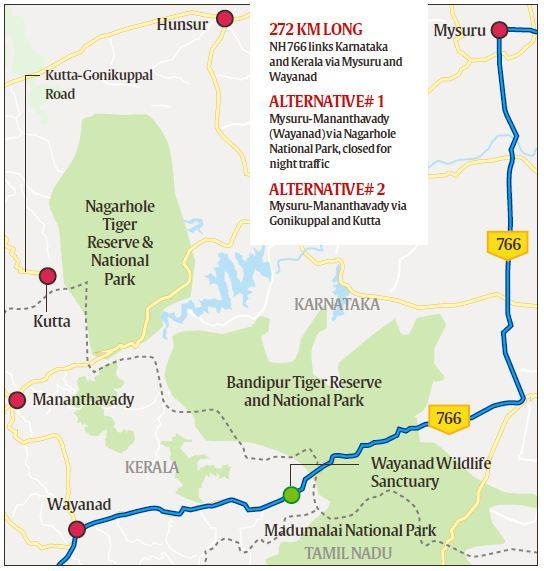
- Location: Both tiger reserves are located in Karnataka and form part of the Nilgiri Biosphere Reserve, India’s first Biosphere Reserve.
- Project Tiger:
- Bandipur was among the first nine Tiger Reserves notified under Project Tiger in 1973.
- Nagarahole was declared a Tiger Reserve of India in 2003.
- Landscape: Together with Mudumalai Tiger Reserve (Tamil Nadu) and Wayanad Wildlife Sanctuary (Kerala), they form one of the largest contiguous protected forest landscapes for tigers and Asian elephants in the world.
- River system: The Kabini Reservoir separates the Bandipur and Nagarahole Tiger Reserve on the North-west.
- Fauna: Tiger, Leopard, Asiatic Wild Dog , Sloth Bear, Asiatic Elephant, Four Horned Antelope, Mouse Deer and South-western langur etc.
- Flora: Predominantly tropical moist deciduous, dry deciduous, and scrub forests, with patches of bamboo and teak.
Source: TH
Previous article
Narcotics Control Bureau Annual Report – 2025
Next article
India and Mauritius: Boost To Strategic Ties
